September 14 – 16, 2026



Location: University of Strathclyde, Glasgow, UK
Organisers: DrLaura Miller (University of Strathclyde) , Professor Apala Majumdar (University of Manchester), Professor Sarka Necasova (Czech Academy of Sciences), Professor Tomas Bodnar (Czech Academy of Sciences)
Funder: London Mathematical Society, INI-HIMR Network: Biological Tissues – Modelling, Mechanics and Applications (August 2025-July 2027) EPSRC EP/V521917/1 – Heilbronn Institute and EP/Z000580//1 – INI.
We are delighted to announce that the international workshop Mathematical Fluid Mechanics (MFM 2026) will take place at the University of Strathclyde, Glasgow, from 14–16 September 2026. This marks the first time the MFM series will be hosted in the UK, following successful meetings in Prague in 2022 and 2024.
About the Event
MFM 2026 will bring together researchers working on the theoretical, analytical, and numerical aspects of fluid mechanics, with a focus on:
- Fluid–solid interaction problems and rheological phenomena, applied to turbulence and complex fluid systems.
- Modelling fluid flows in biological tissues and medicine, including blood perfusion and drug delivery.
- Advances in numerical and analytical methods for fluid dynamics.
Keynotes & Programme Highlights
- 12 invited keynote speakers from leading UK and EU institutions.
- 15 contributed talks, ensuring substantial representation from PhD candidates, postdoctoral researchers, and early career academics.
- Dedicated ECR poster session with flash presentations to foster visibility and engagement.
Roundtable Discussions on UK–EU collaborations and Industry–Academia partnerships.
Keynote Speakers
The MFM 2026 workshop brings together an outstanding group of international keynote speakers whose research spans the forefront of multiscale modelling, fluid mechanics, and applied mathematics. Their expertise covers rigorous analysis, computational methods, and applications across biology, medicine, and engineering, reflecting the breadth and depth of the field.
Boris Muha
Department of Mathematics, University of Zagreb
Professor Boris Muha works on partial differential equations and fluid–structure interaction, especially moving-boundary problems arising in continuum mechanics and biomedicine. His current work also includes poroelastic and next-generation fluid–structure interaction models.
More details can be found here: https://sites.google.com/site/borismuha/home
Raimondo Penta
School of Mathematics and Statistics, University of Glasgow
Professor Raimondo Penta works at the interface of continuum mechanics and mathematical biology. His research spans multiscale homogenization, poroelasticity, porous-media flow and fluid dynamics, with applications including biomechanics, cancer biology, elastic composites, and bone.
More details can be found here: https://regii1.wordpress.com/2025/07/04/raimondo-penta/; https://www.gla.ac.uk/schools/mathematicsstatistics/staff/raimondopenta/
Igor Chernyavsky
Department of Mathematics, University of Manchester
Dr Igor Chernyavsky research focusses on mathematical biophysics and physiology, with a focus on mechanics and transport in complex biological systems. His work includes image-based multiscale modelling of physiological tissues, especially the human placenta, as well as stochastic and transport processes in complex media.
More details can be found here: https://research.manchester.ac.uk/en/persons/igor.chernyavsky/
Adélia Sequeira
Department of Mathematics, Centre for Computational and Stochastic Mathematics Instituto Superior Técnico, University of Lisbon
Professor Adélia Sequeira is a specialist in mathematical and computational modelling of the cardiovascular system, with broader interests in partial differential equations, computational fluid mechanics, particularly focused on inelastic and viscoelastic non-Newtonian fluids and on hemorheology and hemodynamics studies.
More details can be found here: https://www.math.tecnico.ulisboa.pt/~asequeir/
Franck Sueur
Department of Mathematics, University of Luxembourg
Professor Franck Sueur works on partial differential equations in fluid mechanics, including the Euler and Navier–Stokes equations, fluid–structure interaction, multiscale phenomena, and controllability. His work combines rigorous analysis with questions motivated by physical applications.
More details can be found here: https://www.uni.lu/fstm-en/people/franck-sueur/
Sarah Waters
Mathematical Institute, University of Oxford
Professor Sarah Waters specialises in physiological fluid mechanics, tissue biomechanics, and mathematical modelling for medicine and biology. Her work spans classical applied mathematics and interdisciplinary biomedical research developed in collaboration with clinicians, life scientists, and bioengineers.
More details can be found here: https://people.maths.ox.ac.uk/waters/Waters/Dr_Sarah_Waters.html
Arnab Roy
Basque Center for Applied Mathematics
Dr Arnab Roy’s work focusses on fluid flows and fluid–structure interaction, with particular interests in existence, uniqueness, long-time behaviour, and control problems. His research is motivated by applications ranging from medicine and biology to civil, naval, and aerospace engineering.
More details can be found here: https://sites.google.com/view/aroy-math/bio?authuser=0
Šárka Nečasová
Institute of Mathematics, Czech Academy of Sciences
Professor Šárka Nečasová specialises in the mathematical analysis of fluid motion, with a focus on compressible and incompressible Navier–Stokes systems, non-Newtonian and multicomponent flows, and the rigorous analysis of complex fluid models motivated by physical applications.
More details can be found here: https://www.math.cas.cz/public/storage/people/cv/cv_necasova_sarka_20210810234112_54.pdf
Tomáš Bodnár
Faculty of Mechanical Engineering, Czech Technical University in Prague
Professor Tomáš Bodnár works in computational fluid dynamics and numerical analysis. His research focuses on the development and application of numerical methods for complex fluid flows, including biomedical flow modelling and simulations of technologically relevant fluid–mechanics systems.
More details can be found here: https://sciprofiles.com/profile/1936672
Céline Grandmont
Sorbonne University & Inria Paris
Professor Céline Grandmont works in applied mathematics, mathematical modelling, and scientific computing. Her research focuses on the mathematical and numerical analysis of partial differential equations and fluid–structure interaction problems, including coupled fluid–elastic systems and moving-boundary models. Her application areas include the respiratory system, with work on airflow modelling, lung tissue modelling, and aerosol deposition.
More details can be found here: https://team.inria.fr/commedia/grandmont/
Gennady Mishuris
Department of Mathematics, Aberystwyth University
Professor Gennady Mishuris’s research focuses on the mathematical and numerical analysis of problems in solid and continuum mechanics, including singular integral equations, Wiener–Hopf functional equations, wave propagation, and complex composite structures with imperfect interfaces. His application areas span biomechanics, hydraulic fracture, rheology, crack propagation, metal forming, and material testing, with particular expertise in singular fields, soft-tissue mechanics, and plastic and visco-plastic materials.
More details can be found here: https://www.aber.ac.uk/en/maths/staff-profiles/listing/profile/ggm#research
Saumya Bajpai
Mathematics, Indian Institute of Technology Goa
Dr Saumya Bajpai specialises in numerical analysis, partial differential equations, and finite element methods. Her research focuses particularly on the numerical analysis of fluid-flow models, including Navier–Stokes, Kelvin–Voigt viscoelastic, Oldroyd, and Boussinesq systems, with an emphasis on finite element and discontinuous Galerkin methods.
More details can be found here: https://iitgoa.ac.in/MA-faculty-profile/?uid=saumya&&exp=MA
Gaetano Napoli
Department of Mathematics and Applications “Renato Caccioppoli”, University of Naples Federico
Professor Gaetano Napoli works in mathematical physics and continuum mechanics, with particular expertise in the modelling of liquid crystals and soft materials. His research includes nematic liquid crystals on curved surfaces, where he studies the interplay between geometry, topology, elasticity, and molecular alignment, as well as hydrodynamic and deformable-surface models.
More details can be found here: https://www.docenti.unina.it/teacher/47414554414e4f4e41504f4c494e504c47544e37325332304237363650/profile/references
Community Building & Networking
MFM 2026 will provide a platform for building strong UK–EU collaborations, supporting early career researchers, and strengthening links between academia and industry.
Conference Fee & Dates
The deadline for booking is 13th September 2026. For registration and booking please refer to the Registration section.
| Standard Delegate | £180.00 |
| Online only Delegate | £0.00 |
If you would like to give a contributed talk, please send your abstract 300 words, plain text to scientific@mfm-in.com for consideration. Deadline for the submission of abstracts for contributed talks and posters is July 19th.
Venue, Travel and Accommodation Information
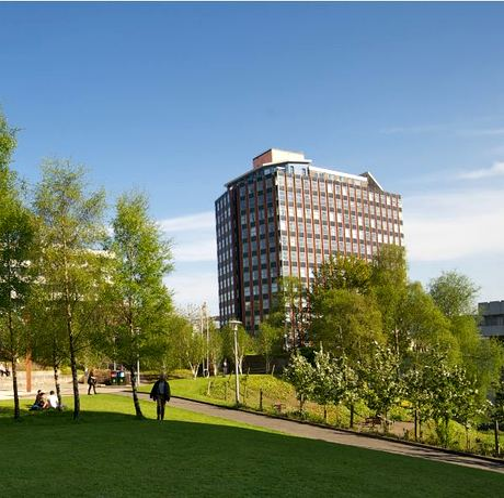
Venue Address: Livingstone Tower, University of Strathclyde, 26 Richmond Street, Glasgow, G1 1XH. Room: LT908. Google Maps: https://maps.app.goo.gl/vS1j4G6bnSGv4XRG8
Livingstone Tower is located on the University of Strathclyde’s city-centre campus, close to George Square, Merchant City, Buchanan Street, Glasgow Cathedral, and many shops, cafés, restaurants, bars, hotels and other local amenities. The city-centre campus is within easy walking distance of Glasgow’s two main railway stations, Buchanan Bus Station and the Subway network
Getting to the Venue
Arriving by Air: Glasgow Airport
Glasgow Airport is the closest airport to the venue. The Glasgow Airport Express Service 500 is the official airport bus service connecting Glasgow Airport with Glasgow city-centre. It runs between the airport and key city-centre stops, including Buchanan Bus Station, with journey times advertised from around 15 minutes depending on traffic.
From Buchanan Bus Station, Livingstone Tower is approximately a 10–15 minute walk, or a short taxi journey.
Taxis are also available from Glasgow Airport directly to the University. Journey times vary depending on traffic, but delegates should allow extra time during peak commuting periods.
Arriving by Air: Edinburgh Airport
Delegates arriving at Edinburgh Airport can travel directly to Glasgow using the Citylink AIR / Glasgow 900 coach service, which links Edinburgh Airport with Glasgow Buchanan Bus Station. This service runs up to every 20 minutes during parts of the day, with an average journey time of around one hour.
Alternatively, delegates can take the tram from Edinburgh Airport into Edinburgh city centre and then take a train from Edinburgh Waverley to Glasgow Queen Street. Edinburgh Trams run frequent services between the airport and the city centre, and ScotRail operates direct trains between Edinburgh Waverley and Glasgow Queen Street.
Arriving by Train
The nearest major railway stations are:
- Glasgow Queen Street: Queen Street is the closest mainline station to the venue and is approximately 0.4 miles from campus, around a 7-minute walk.
- Glasgow Central: Glasgow Central is also within walking distance at approximately 0.9 miles from campus, around a 14-minute walk.
Delegates may also take a short taxi from either station. Glasgow Queen Street is usually the most convenient station for those travelling from Edinburgh, while Glasgow Central is often the arrival point for trains from London, Manchester, Birmingham and other parts of the UK.
Arriving by Road and Parking
The University of Strathclyde is located in Glasgow city-centre and parking on campus is limited. The University encourages visitors to use sustainable transport where possible. Delegates are advised not to rely on campus parking.
Delegates driving into Glasgow should also be aware that Glasgow city-centre operates a Low Emission Zone. Any vehicles entering the city-centre zone must meet the required emission standards or may receive a penalty charge. Further information can be found here Glasgow’s Low Emission Zone – Glasgow City Council
Those travelling by car may wish to use nearby public city-centre car parks, such as those around George Street, Duke Street, Merchant City or Buchanan Galleries, and should check prices, opening hours, height restrictions and LEZ compliance before travelling.
Accommodation
A range of accommodation options is available within walking distance of the University. Delegates are advised to book accommodation early, as availability and rates may vary depending on local events and demand.
Suggested nearby accommodation options include:
| Hotel | Location |
| Premier Inn Glasgow City Centre George Square | Centrally located near George Square and within walking distance of the University. |
| ibis Styles Glasgow Centre George Square | Located close to George Square and Merchant City, with convenient access to restaurants and city-centre amenities. |
| Motel One Glasgow | Located close to Glasgow Central Station, suitable for delegates arriving by train. |
| Moxy Glasgow Merchant City | Located in Merchant City and very close to the University campus. |
| Maldron Hotel Glasgow City | Located near Buchanan Street, Theatreland and Buchanan Bus Station, convenient for delegates arriving by airport bus. |
| AC Hotel Glasgow | Located on George Street, close to George Square and within easy walking distance of the venue. |
Delegates may also wish to search for accommodation in the areas around Merchant City, George Square, Buchanan Street, Glasgow Queen Street Station or Glasgow Central Station, all of which are convenient for the venue.
Local Amenities The venue is located in Glasgow city centre, with easy access to cafés, restaurants, shops, supermarkets, pharmacies, hotels and public transport. The campus is close to Merchant City, George Square, Buchanan Street, Glasgow Cathedral and the city’s main shopping and cultural areas.
Contact
- scientific@mfm-in.com – scientific issues
- support@mfm-in.com – general questions, registration, paperwork
Scientific committee:
Organizing committee: